



Far too easily pleased.
Scripture in this message: 2 Corinthians 4:17-18
This is the message as Pastor Mark wrote it, lightly edited so it reads clearly on the page. It is his prepared text, so it may differ here and there from what he said on Sunday.
Quotations from C.S. Lewis are shortened, with the surrounding summary in Pastor Mark's own words.
The message
If you are new with us today, or if you’ve been traveling and are popping back in, you have landed right in this capstone moment of our entire summer season of sermons.
Eight Weeks with Lewis: A Look Back
For the last two months, eight weeks straight now, we have been on a journey together called A Summer with C.S. Lewis.
As we step into early August here in Clovis, with the summer heat baking the valley and the quiet restlessness of a new school year beginning to pull at our routines, we come to the final Sunday of this series which I have really enjoyed.
Think back to where we started in mid-June.
On our very first Sunday together, we opened up the life of Clive Staples Lewis.
We looked at a man who, for the first half of his life, lived under a tragic and painful contradiction.
He was a brilliant Oxford scholar who confessed that for years, nearly everything he believed to be real he found grim, cold, and meaningless, and nearly everything he loved and desperately desired, he believed to be entirely imaginary.
He was a man haunted by a feeling, a bittersweet and piercing ache.
We talked about that late September night in 1931, walking down Addison’s Walk under the Oxford trees with his friends J.R.R. Tolkien and Hugo Dyson, as they helped him realize that the deep ache in his heart wasn't an illusion.
It wasn't a trick of psychology. It was a compass pointing to the True Myth, to Jesus Christ, the story that actually happened.
Over this summer, we’ve tracked that ache through his writings.
● We strolled through Mere Christianity and saw the rock-solid reasonable foundation of the Gospel. ● We walked through A Grief Observed with Tim, staring honestly into the dark valley of human loss. ● We looked at The Great Divorce, picturing those poor, ghostly phantoms stepping off the bus into the Solid Country, realizing that their feet were too thin and transparent to stand on the grass of Heaven, while the citizens of glory pleaded with them, "If you stay, you will grow solid."
● We peeled back the curtains in The Screwtape Letters to expose the quiet, insidious strategy of the enemy, not to shock us with grand scandals, but to drift us down the gentle slope, soft underfoot, getting us to prefer nothing over Christ until our lives evaporate into thin air. ● And just last week, Kyle took us deep into Narnia, standing beside the Stone Table, staring at the Great Lion who is not safe, but who is unquestionably good, leaving us with an ache to know that God better than we do today.
Today, we are taking all eight weeks of imagination, narrative, and theology, and we are landing them squarely on a single, apostolic text.
Oxford, June 1941: The Sermon Behind the Sermon
Today, we look at the sermon that C.S. Lewis himself preached, the only time in this entire series where we aren't looking at a book he published, but a sermon he delivered in a pulpit.
It was called The Weight of Glory.
I want to take you back to the exact moment this message was born.
The date was June 8, 1941, and the venue was the Church of St. Mary the Virgin in Oxford, England.
To understand the power of what was said that night, it was evensong, so that means an evening service, but to understand it, you have to understand the air the people were breathing. It was June of 1941.
Britain was standing almost entirely alone in the absolute darkest, most terrifying stretch of the Second World War.
The Nazi Blitz had been pounding English cities into rubble for months.
Millions of families were sleeping in underground subway stations, clutching gas masks in the dark, listening to the siren wails and the dull thud of high explosives, wondering if their home, or their children, would still be alive when the sun came up.
Food was heavily rationed.
Death was not an abstract theological concept, reality was the dust on their coats and the morning headline.
On an early summer evening in Oxford, a middle-aged, conservative Anglican layman, an Oxford literature scholar, not an ordained priest or pastor, stood up in the pulpit of St. Mary’s to address a sanctuary packed with students, soldiers, and grieving families.
What do you preach to a nation under fire?
What do you say to people whose world is literally crumbling around their ears?
If you or I were drafting that sermon, we’d probably preach on endurance.
We’d preach on survival.
We’d offer a soft, comfortable message to help people just make it through the week.
Lewis didn't do any of that. He stood up in that pulpit and he talked about desire.
He talked about eternal glory.
He spoke to a room full of tired, frightened mortals and told them that the problem with human beings has never been that we want too much, our problem is that we don't want nearly enough.
He opened his sermon with words that have echoed down through the last eighty-five years:
We are half-hearted creatures, fooling about with drink and sex and ambition when infinite joy is offered us, like an ignorant child who wants to go on making mud pies in a slum because he cannot imagine what is meant by the offer of a holiday at the sea. We are far too easily pleased.
C.S. Lewis, The Weight of Glory
Given the size of what the Gospels actually promise, Lewis says, our Lord finds our desires not too strong but far too weak.
Picture that image for a second.
Imagine a little child in the 1940s, crouched in the filthy, oil-stained dirt of a back-alley slum.
He’s completely absorbed. He’s making a sad little mud pie in the gutter, wiping his dirty nose on his sleeve, but totally content.
A car pulls up to the curb. His parents lean out the window and say:
"Leave the dirt. We have rented a house on the coast. The sun is shining, the ocean waves are rolling in, the air is clean, and we are going to the sea."
The child looks up, blinks, looks back at his puddle of muddy dirt, and says:
"No thanks. I'd rather stay here and play with this mud."
Why does he say that?
Because he has no category for the ocean in his mind!
He has never seen the sea. He cannot conceive of the sparkling water and vast horizons, so he just clings to the dirty water in front of him because the mud is real to him, and the sea is just a word.
Lewis looks at us and says that is every single one of us.
We often think the spiritual life is about learning to want less.
We often think holiness means taming our big, aggressive desires, dialing them back, turning down the volume, and becoming quiet, low-energy rule-followers.
Jesus stands in the Gospel and says:
"You’ve got it completely backward! Your problem isn't that you are too greedy for joy; it’s that you are far too easily pleased!"
We are trying to satisfy an infinite, God-sized hunger with a promotion, or a bigger house in the best neighborhood, or a 401(k) target, or a flawless vacation, or even three hours of mindlessly scrolling through videos on a glass screen.
We are aiming an engine built for the ocean of faith experiences, at a puddle in a back alley, and then we sit there at 11:30 on any given night wondering why we still feel hollow inside.
The ache we feel, that sharp, bittersweet longing that hits us when we watched the sunset over the Sierra Nevadas, or held our newborn child, or listened to a piece of music that made your chest tight, was never meant to be satisfied by the creation itself.
Those things are signposts, not the destination.
In week one I said they are like the scent of a flower we haven't found, the echo of a tune we haven't heard, news from a country we have never yet visited.
If you are carrying a quiet disappointment with a life that was supposed to make you happy, if you are tired of eating dirt out of a lawnmower bag when the King has prepared a feast, then listen to me today.
Our pain has a point.
Our longings are not a defect within us. The God who created us is using the very friction of this life to forge in us something so heavy, so massive, and so eternal that standard human language breaks under the weight of it.
Turn with me in your Bibles to 2 Corinthians chapter 4, verses 17 and 18. This is the biblical backbone that Lewis hangs his entire sermon on.
It’s also where we start the first point in this sermon.
Point 1: The Outrageous Math of the Gospel
Look at what the Apostle Paul writes to the church at Corinth.
“For our light and momentary troubles are achieving for us an eternal glory that far outweighs them all. So we fix our eyes not on what is seen, but on what is unseen, since what is seen is temporary, but what is unseen is eternal.”
2 Corinthians 4:17-18
I want us to slow down and really look at the words on this page, because if we gloss over this too quickly, we will mistake Paul for a sentimental optimist who doesn't understand real human suffering.
Paul calls our troubles light and momentary.
Let’s pause there, though.
Who is writing this?
Is this a comfortable, sheltered academic, sitting in a climate-controlled study sipping tea?
No! This is Paul!
The man who was whipped with thirty-nine lashes five different times, the man who was beaten with rods, pelted with stones and left for dead, shipwrecked three times, spent a night and a day drifting in the open sea, lived in constant danger, went without food, without sleep, in cold and exposure, carrying the daily pressure of all the churches!
If anyone had the right to write an encyclopedia on human suffering, it was Paul.
Yet when Paul looks at his life, when he looks at the scars covering his back, the chronic pain of his thorn in the flesh, the prison chains around his wrists, he picks up a pen and writes:
These troubles are light. They are momentary. How can he say that? Is he crazy? Is he minimizing human pain?
No. He is doing the math.
Paul is holding a balance scale in his mind.
On the left side of the scale, he places all of his earthly suffering. He places the cancer diagnoses. He places the empty chair at the dinner table. He places the betrayal of a friend, the financial ruin, the chronic depression, the physical decay of an aging body.
He places the whole crushing, suffocating stack of present human misery on the left side of the scale.
Then, on the right side of the scale, he places what God is doing, an eternal weight of glory.
The moment that eternal glory touches the right side, the left side flies up like a feather in the wind!
It’s not that the suffering isn't real, it’s that the glory is so outrageously heavy that it renders the suffering comparatively weightless!
In Romans 8:18, Paul puts it this way.
“I consider that our present sufferings are not worth comparing with the glory that will be revealed in us.”
Romans 8:18
Notice he doesn't even say:
"If you compare them, glory wins."
He says they aren't even worth comparing!
It’s like trying to compare the weight of a single speck of dust floating in the air to the weight of Mount Everest.
To understand why Paul uses the phrase "weight of glory”, we have to understand how his mind worked.
Paul was a scholar of the Hebrew Scriptures writing in Greek.
In our modern English language, the word glory sounds bright, shiny, and visual.
We think of light beams, or clouds, or golden halos.
Glory Means Weight, Not Shine
In Hebrew, though, the primary word for glory is Kabod, and the root meaning of kabod isn't shine or light, it is weight.
It means heaviness. It means substance, mass, and significance.
To have kabod means you are not a shadow. You are not a thin, wispy ghost that can be blown away by the wind.
You have mass. You are solid. You carry gravity.
Call back for a second to what we looked at three weeks ago in The Great Divorce.
Remember how Lewis pictured Heaven? Heaven wasn't a cloud where people floated around playing harps. Heaven was so dense, so solid, so heavy with reality that the rain felt like thrown diamonds and the grass pricked the feet of the ghostlike tourists like needles of steel.
The ghosts were thin and hollow because they had spent their lives worshipping the shadow of self. The citizens of Heaven, though, were heavy, solid, and bright.
Glory is substance.
Now, look at the verb Paul uses in 2 Corinthians 4:17. This is where the whole sermon pivots.
Paul writes, "Our light and momentary troubles are achieving for us an eternal glory."
The Greek word there is katergazetai. It doesn't mean "preceding."
It doesn't say, "You go through trouble, and then later on, bad luck stops and glory happens."
Katergazetai means to produce, to work out, to forge, to achieve.
Our present affliction is not merely followed by glory, our present affliction is PRODUCING our glory!
The suffering isn't a detour. It isn't a tragic interruption to your real life. It isn't wasted time.
If you belong to Jesus Christ, your suffering is the workshop where the Holy Spirit is actively forging the eternal weight of your glory!
Think about how gold is refined. The apostle Peter uses this exact image in 1 Peter 1:6-7:
“In all this you greatly rejoice, though now for a little while you may have had to suffer grief in all kinds of trials. These have come so that the proven genuineness of your faith—of greater worth than gold, which perishes even though refined by fire—may result in praise, glory and honor when Jesus Christ is revealed.”
1 Peter 1:6-7
Peter uses the word dokimion, the technical term for the quality assessment and testing of precious metal in the furnace.
When gold ore goes into the crucible, the fire burns away the impurities, the slag. The fire, however, doesn't destroy the gold. It purifies it, so that what comes out of the furnace is pure, heavy, solid metal.
When you go through a season of grief, when you carry a physical affliction, when you suffer a betrayal, when you pray an unanswered prayer for years, the enemy wants you to think:
"God has forgotten me. My life is falling apart. This pain is meaningless."
The Word of God shouts back into your darkness, though, that no moment of this pain is gratuitous, none of it is thrown away!
God is using the very fire we are walking through to burn away the thin, flimsy idols we’ve been clinging to, the mud pies we thought were enough, and He is making our soul heavy, solid, and fit to bear eternal glory.
Point 2: What Is True Glory
The second thing we will pull from this is the answer to the question, what is true glory?
We have to ask this very honest question.
What actually is this glory that Paul is talking about?
What is this weight that is being forged in us?
When Lewis began studying this in Scripture, he confessed that for a long time, the Christian idea of "glory" sounded deeply unappealing, almost offensive to him.
Why? Because in human terms, "glory" usually means two things:
1. Fame, standing on a stage while hundreds, thousands or even millions of people clap for you, or 2. Luminosity, shining like an electric lightbulb.
Lewis thought:
Is God so vain that He created human beings just so we could stand around applauding Him forever?
Do I really want to spend eternity turned into a light fixture?
It sounded like a divine talent show where people get handed shiny ribbons.
As Lewis dug into the text, though, he realized that biblical glory isn't about human vanity. It is about something far deeper than that.
In the Gospels, true glory comes down to two staggering realities.
In the Gospels, true glory comes down to two staggering realities: being noticed by God, and being welcomed in.
Think about human nature for a moment. What is the deepest longing of a child?
It’s when a little boy jumps off the diving board into the pool and yells:
"Hey Dad, watch this!"
He doesn't care if the rest of the crowded public pool is watching.
He doesn't care about the applause of strangers. He wants the approving, delighting eyes of his father.
Or think about flying. Yes, I am back to that!
In my flying career I experienced two particular flights I won’t forget in a hurry, the first was memorable because it was bad weather and I had no auto-pilot so for over an hour I flew in bad clouds, rain, and winds at night, no visibility, choppy turbulence, winds pushing me down, and I spent the whole flight staring at instruments, sweating and doing my best to execute every procedure with intense precision. Probably should have not flown that flight, but it’s history now. The other was flying into Vegas on a charter flight, yes an auto pilot this time, but was acting more like a roller coaster than an airplane.
When you finally park the plane, shut down the engines, and step out onto the ramp, and the other pilot who was with you says, "Outstanding job out there in the storm today."
That single moment of recognition from a person whose opinion counts to you, carries immense weight.
That is what Jesus promises us.
Matthew 25:21 says.
“His master replied, 'Well done, good and faithful servant! You have been faithful with a few things; I will put you in charge of many things. Come and share your master's happiness!'”
Matthew 25:21
It’s important to realize what Scripture is saying.
For those who are in Christ Jesus, the final moment of human history is not just safety. It is not merely escaping condemnation.
It is stepping out of the cold, foggy, exhausting storm of this world, walking through the doors of eternity, looking into the eyes of the God who spoke galaxies into existence, and hearing Him say to you:
"Well done. Good job. I saw what you endured. I saw the quiet obedience nobody else noticed. I saw the tears you cried over that lost child. I saw the integrity you maintained when it cost you your job. Welcome home. Come share my happiness."
To be recognized by God, to be accepted by Him, to have the Creator of the universe look at a forgiven, blood-bought sinner and delight in them, that is the Weight of Glory.
Years ago, in another series, I preached on our primary identity and purpose.
I said plainly at that time, "Your primary purpose is to bring glory to God."
That is eternally true.
The Weight of Glory, though, turns that direction around and hands us the unexpected flip side.
Not only do we give glory to God, but in Christ, we receive glory, approval, and acceptance from the One who already knows every flaw, every secret, and every stain in our hearts, yet sees to it that we are clothed in the righteousness of His Son!
1 Corinthians 2:9 captures the sheer scale of what God has waiting for us.
“What no eye has seen, what no ear has heard, and what no human mind has conceived—the things God has prepared for those who love him.”
1 Corinthians 2:9
We have to stop trying to force this present world we live in to be our Heaven.
We should stop demanding that our spouse, our job, our retirement, or our health gives us what only the presence of God can provide.
The ocean is real. The trip to the sea is coming.
Point 3: The Gospel Turn, Cross Before Crown
Now, how do we get there?
How does a room full of broken, imperfect people living in Clovis, California in 2026 actually inherit this weight of glory?
This is where we must make the vital Gospel Turn.
Because if we aren't careful, we can listen to a sermon like this and think:
"Okay, so I just need to bear my suffering bravely, pull myself up by my bootstraps, earn my way into God's approval, and then I'll get my glory reward."
If you think that, you have completely missed the Gospel.
You and I cannot forge glory in ourselves.
On our own, our righteousness is like filthy rags.
Left to ourselves, we would spend our entire lives wallowing in the mud pies of sin, self-absorption, and pride until we evaporated into spiritual non-existence.
There was only One who possessed original, uncreated, infinite Glory: the Eternal Son of God.
Look at what He did.
He left the weight of heavenly glory. He laid aside His divine majesty. He stepped down into our muddy, broken, disease-ridden slum. He took on frail human flesh.
On a dark Friday afternoon outside the walls of Jerusalem, Glory Himself was stripped naked, beaten, mocked, and nailed to a Roman cross.
Why?
Because on the cross, Jesus Christ took upon His own shoulders the crushing, suffocating weight of our sin.
He bore the condemnation we deserved. He experienced the ultimate rejection, being cast out into the outer darkness, crying out:
"My God, my God, why have you forsaken me?", so that you and I could experience the ultimate acceptance!
He took our lightness, our vanity, our mud, and our shame, and in exchange, He handed us His weight, His righteousness, and His eternal glory.
Lewis put it in one unforgettable line near the end of his sermon.
"Meanwhile the cross comes before the crown, and tomorrow is a Monday morning. A cleft has opened in the pitiless walls of the world, and we are invited to follow our great Captain inside."
The Weight of Glory
The cross comes before the crown.
Jesus did not skip the cross to get to the glory. He reached the crown through the cross. Because we are united to Him by faith, that exact same pattern runs straight through our lives today.
Our current trials, our current afflictions, our current sacrifices, it is not evidence that God has abandoned us.
It is evidence that we are following our Captain through the cleft in the wall!
He is leading us along the exact same path.
He walked through the cross, straight into the eternal weight of glory.
Point 4: There Are No Ordinary People
This brings us to the final, razor-sharp part of Lewis’s message, that there are no ordinary people.
If all of this is true, if we are made for another world, if Christ died to raise us up into eternal glory, then how does that change how we walk out of our doors on Monday morning?
This isn't just theology for our bulletin note section or a notebook. This is a radical new lens for our eyeballs.
Lewis takes this vast, cosmic concept of eternal glory and he swings it around and points it directly at the person sitting in the row in front of you, or bedside you, or in your own seat.
Listen to how he concludes The Weight of Glory:
It is a serious thing to live in a society of possible gods and goddesses, to remember that the dullest and most uninteresting person you talk to may one day be a creature which, if you saw it now, you would be strongly tempted to worship.
C.S. Lewis, The Weight of Glory
Notice that he does not leave it there. The same person, he says, could just as easily be going the other way, and every conversation we have is a small push toward one destination or the other. Here is where he lands it.
There are no ordinary people. You have never talked to a mere mortal.
C.S. Lewis, The Weight of Glory
Let that sink in for a second this morning.
There are no ordinary people.
You have never in your entire life locked eyes with a "mere mortal."
Think about what Lewis is saying, in his sermon, he compares human beings to entire civilizations, nations, empires, political parties, mega-corporations, cultural movements, artistic traditions.
Those things feel so big and permanent to us, don't they?
We spend our whole lives obsessing over politics, national news, market trends, and cultural movements.
Yet Lewis points out that all of those giant institutions are mortal!
Nations rise and fall.
Empires turn to dust.
Corporations go bankrupt.
Their entire lifespan compared to eternity is like the brief, insignificant life of a gnat!
The person sitting next to you right now, though?
The barista who got your order wrong this morning?
The exhausting coworker who takes credit for your ideas in the Monday staff meeting?
The driver who cut you off on Temperance roundabout?
The spouse whose irritating quirks are getting on your last nerve?
They will outlive every nation on earth.
Years from today, when the world is no longer the same as it is now, and the promised return of Christ is complete, the soul of that irritating driver will still be alive somewhere.
They will either be a radiant, resurrected creature reflecting the majestic glory of God, or an eternal, self-consumed tragedy.
Last fall, in those one week wonderings sermons, I talked about Making Life Count. I talked about our legacy.
I said that someone is always watching what we do. I called it unintentional mentoring.
I asked what kind of footprint we are leaving behind: one that washes away with the waves, or one that lasts?
Here is the ultimate extension of that truth. Our legacy is written in the immortal souls of the everyday people around you, every single day, in how we talk to our kids, how we treat our waiter, how we forgive our spouse, how we respond to an angry email, how we share the Gospel with a friend.
We are holding the weight of an immortal soul.
We are helping nudge them either a fraction of an inch closer to the radiant glory of Christ, or a fraction of an inch deeper into the dark slum of self-absorption.
How would our week change if we stopped viewing people as obstacles, speedbumps, or background scenery in the story of our life, and started viewing them as immortals carrying the potential weight of glory?
Jesus said the exact same thing in Matthew 25.
He said that when we give a cup of cold water to the thirsty, when we visit the sick, when we welcome the stranger, we aren't just doing a nice social deed, we are encountering Him.
Glory Himself is hidden in the face of our neighbor.
So where does that leave us as we bring this eight-week summer journey to a close?
We have spent two months leaning into the brilliant imagination of C.S. Lewis.
● We’ve seen the grand architecture of Christian truth. ● We’ve looked into the dark mirror of human grief. ● We’ve felt the frightening danger of drifting into spiritual thinness. ● We’ve stood before the fierce, good Lion of Judah.
Today, we stand at the table.
Earlier in the service, Pastor Marc Scott led us into Communion, and there is no place in the world where The Weight of Glory lands more perfectly than right here at this table.
Because look at what is set before us in that process, a tiny piece of bread, a small cup of juice.
To the world, this looks completely light, trivial, and insignificant. It looks like nothing, certainly no meal.
By the power of the Holy Spirit, though, as we eat this bread and drink this cup in faith, we are remembering the exact moment where the infinite, heavy Glory of God was broken for us.
This bread represents the body that bore our affliction.
This cup represents the blood that bought our eternal inheritance.
At this table, the cross and the crown meet.
At this table, we are reminded that our present suffering is not the end of the story, it is the birth pangs of eternal glory.
I want to address four specific groups of people in this room today.
To those in a long, dark, unanswered season of suffering.
Hear me clearly. Your affliction is not a mistake. It is not wasted time.
God has not forgotten you in the furnace.
He is actively using this very trial to refine your faith like pure gold and forge in you an eternal weight of glory that will make your current pain feel like a passing breath. Do not lose heart.
To those who got everything they ever wanted in life, but found it strangely empty.
You aren't crazy, and you aren't ungrateful.
You are just hungry for the sea. Stop trying to make this earthly life perform like Heaven.
Let go of the mud pies today, and turn your eyes back to Jesus, the only One who can satisfy the ache in your chest.
To those busy, capable people running on autopilot.
Slow down this week. Look at the people in your home, your workplace, and your neighborhood.
Remember that there are no ordinary people.
Pick one person this week you’ve treated as background scenery, and carry the weight of their glory through one intentional, sacrificial act of love.
Finally, to those carrying heavy grief over loved ones who do not yet know Christ.
You do not carry the burden of being their judge.
You are asked to trust the Judge of all the earth, who is far more merciful, patient, and loving than we could ever dream.
Keep praying. Keep loving them. Keep pointing them to the light.
As we finish this summer with Lewis, let’s leave the slum behind.
Let’s fix our eyes not on what is seen, but on what is unseen.
Because the cleft in the wall has been opened.
Our great Captain has gone before us. The cross is present, but the crown is certain.
Next Sunday, as we pivot into our new series, Tell Me Who You Are, we are going to look directly into the face of the God who called us out of the darkness and into His marvelous, heavy, eternal light, and see his attributes clearly.
Let’s pray together.
Father in Heaven.
We confess to You this morning that we have been far too easily pleased. We have squandered our God-given longings on small, cheap, broken things that could never love us back. We have chosen mud pies in the slum over the vast, beautiful ocean of Your grace.
Forgive us, Lord.
For those in this room who are walking through intense fire right now, those carrying physical illness, marital distress, deep grief, or quiet exhaustion, I pray that You would give them eyes to see 2 Corinthians 4:17.
Remind them that their pain is not wasted.
Remind them that You are using this light and momentary trouble to forge in them an eternal weight of glory beyond all comparison.
As we come to this table today, open our eyes to the cross.
Remind us of the sacrifice of Your Son, Jesus Christ, who took our sin so that we could share in His glory. And as we leave this place, help us to look at our neighbors with holy awe, remembering that there are no ordinary people.
We ask all of this in the mighty, glorious, and unrivaled name of Jesus Christ, our Lord and Savior.
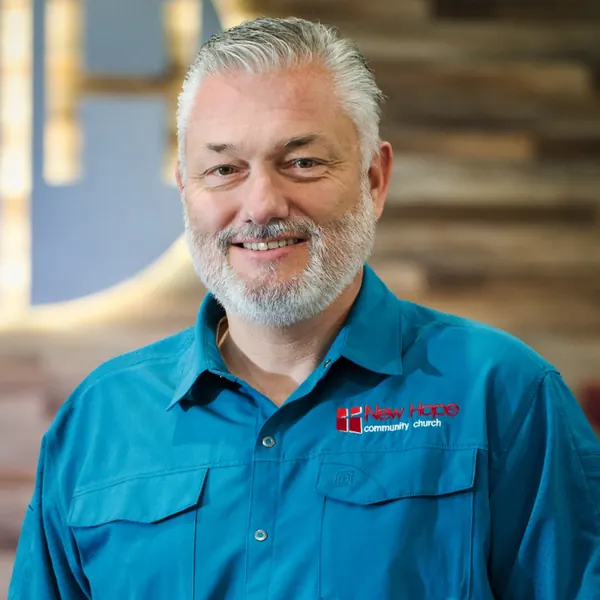
Mark
Addis
Senior Pastor of New Hope Community Church.
Senior Pastor at New Hope since December 2022. Joined as an elder board member and Associate Pastor in 2016. Master's from Moody Bible Institute, and a Commercial Pilot license.
This message is part of A Summer with C.S. Lewis, an eight week series on the man whose books have pointed so many people toward Christ. Every message in the series is gathered there.
You're welcome at New Hope.
All three Sunday services at 8, 9:30, and 11 AM are identical, same teaching and same worship, so come at the hour that works for you.
Get directions (opens Google Maps in a new tab)