

Two kinds of people in the end.
Scripture in this message: Luke 16:19-26
This is the message as Pastor Mark wrote it, lightly edited so it reads clearly on the page. It is his prepared text, so it may differ here and there from what he said on Sunday.
Quotations from C.S. Lewis are shortened, with the surrounding summary in Pastor Mark's own words.
The message
Have you ever tried to cross an international border on foot, perhaps the Mexican or United States border, or even in a vehicle, from here to Canada?
You're there, and you’re standing in line or sitting in a vehicle, clutching your passport, and you notice there is a very clear, very distinct line painted on the concrete floor, or a division in the road, where one country becomes another.
On one side of that line, you are under the jurisdiction of one country, on the other side everything changes.
The laws are different, often generally the same, but there can be some surprising differences, the currency is different, suddenly cash in our pocket becomes instantly useless, without changing it, and the authority is different.
You can't stand with one foot on the left side of the line and one foot on the right side and expect both countries to just be okay with it.
I did that once on the road that heads north out of the Ivory Coast into Burkina Faso. There were no border agents, no military, not even a single police car. There was just a sign that said Welcome to Burkina Faso on one side, and on the other side, Welcome to Cote d’Ivoire.
This was in 2012 so it may be different now, but I was surprised with this lack of any kind of legal process from one side to the other.
I could stand on the road with one foot in Burkina Faso, and one foot in the Ivory Coast, but that’s all I could do, if I moved 2 feet one way or the other, I was back in one or the other country.
Because in order to have any kind of practical life, we need to make a choice.
In a more formal border crossing, the immigration agent will look at you and say:
"Sir, you need to make a choice. Step across, or step back."
In our spiritual lives, though, we hate lines like that. We love the idea of a gray zone.
We want to believe that if we just drift along, if we just wait long enough, every single road we take will eventually merge into the exact same highway.
We want to believe that Good and Evil can eventually strike up a compromise.
Well, we are in week five of our summer series on C.S. Lewis, and today we come to a book he wrote in 1945 specifically to shatter that exact illusion.
It’s called The Great Divorce. I read this book earlier this week with somewhat low expectations. No idea why, maybe it was the title, but I have to say that it is a book I enjoyed way more than I expected to. It was very engaging.
The title, whatever feeling I felt from it, is actually itself an argument.
It answers William Blake's poem The Marriage of Heaven and Hell, in which evil is treated as a vital ingredient of creativity and happiness.
Lewis wrote his book in part as a rebuttal, insisting in his own preface that there is no marriage, only a divorce, and that evil can be undone but never developed into good.
A mathematical calculation can only be put right by going back to the error and working it from the start, if you just continue it’s only going to get worse, and will never be solved.
Or, if you make an architectural error on the foundation of a building, the building doesn’t straighten itself out by just adding more floors.
The only way to fix it is to go back to the error and work on it from the beginning.
He argues that evil in life can be undone, but it can never develop into good.
Heaven and Hell are not a marriage. They are a divorce.
To illustrate this, in this book Lewis invites us into a dream, or as it is described, a literary "supposal."
It is not the most comfortable book to read, because of the great truth that’s illustrated in it, but it is powerful.
He begins with a line, a queue for a bus, of course he was British so dreaming of queues comes naturally, but he pictures a public bus pulling up in a drab, rain-soaked city where it is always a dismal, continuous evening.
Grey Town & the Bus to Heaven
It’s called the Grey Town, and the people living in Grey Town aren't monstrous criminals, they are just incredibly self-centered, ordinary people who spend eternity moving further and further away from each other because they can't stand anyone else's company.
A bus arrives to take anyone who wants a holiday up to the foothills of Heaven. The passengers in line get on, not before some of them had engaged in arguments and fist fights which brought the number down before they even got on the bus.
This gives you some idea of the environment he’s describing, it’s not a pleasant place.
The bus leaves, and soon the bus climbs up into the light, it leaves the ground, and climbs up into the light. I know some of you parents are out there thinking, sure I’ve seen that kids show. The Magic Schoolbus! Not quite the same, but you get the idea!
In the process of this climb up and arriving, the passengers change.
They become transparent, ghostly, like smudges of smoke. They all look like they did in life, but now just a ghostly shell of what they were in Grey Town.
Eventually, the bus doors open at the foothills of Heaven, which Lewis calls the "Solid Country", and these ghosts step out into a reality that shocks them.
The light is so pure it feels like a threat to their darkness. The grass is so real, so solid, that it literally hurts their ghostly, transparent feet to walk on it. It’s like walking on sharp diamonds. Everything feels so hard to them, and hurts them. The character narrating the story tries to pick a flower but it becomes incredibly painful to him so he gives up.
Then, shining people, the citizens of Heaven who actually knew these ghosts on earth, come walking down the mountainside. They approach their known ghost, not to judge them, not to mock them, but to plead with them.
They say:
"Come on up. Step off the bus. Stay here. If you stay, you will grow solid. Every step you take into the mountains, your feet will get harder, and the grass will stop hurting. Come home."
Do you know what happens? Almost every single one of those ghosts gets back on the bus.
Not because Heaven locked the doors, not because God turned them away, but because each of them was clutching something, some small grievances, some small ambition, some tiny piece of independent control, that they refused to drop long enough to become real.
They chose the Grey Town, and it begs a question that should make every one of us pause this morning. Why do we choose to stay transparent when reality is right in front of us?
There are three things I want to pull from this book this morning, there’s plenty more, but for the sake of time I will stick to these three.
Point 1: The Settled Chasm (Luke 16)
The Weight of the settled chasm, and you think what on earth does that mean, bear with me.
If you have your Bibles, open them to Luke chapter 16, this is a passage that gives The Great Divorce its theological spine.
It is the literal ‘great divorce’ spoken of by Jesus Himself.
It is unique, too, because it’s the only place in scripture where Jesus names a character in a parable, and it’s the only glimpse we get of a man in Hell speaking.
Look at Luke 16, starting in verse 19.
“19 “There was a rich man who was dressed in purple and fine linen and lived in luxury every day. 20 At his gate was laid a beggar named Lazarus, covered with sores 21 and longing to eat what fell from the rich man’s table. Even the dogs came and licked his sores. 22 “The time came when the beggar died and the angels carried him to Abraham’s side. The rich man also died and was buried. 23 In Hades, where he was in torment, he looked up and saw Abraham far away, with Lazarus by his side. 24 So he called to him, ‘Father Abraham, have pity on me and send Lazarus to dip the tip of his finger in water and cool my tongue, because I am in agony in this fire.’. 25 “But Abraham replied, ‘Son, remember that in your lifetime you received your good things, while Lazarus received bad things, but now he is comforted here and you are in agony. 26 And besides all this, between us and you a great chasm has been set in place, so that those who want to go from here to you cannot, nor can anyone cross over from there to us.’”
Luke 16:19-26
I want you to look closely at that word chasm.
In the original Greek text, the word is chasma, where we get our English word. It means a gaping gulf, a massive spatial separation.
Right next to it in this passage, where it says ‘set in place’, is a form of the word sterizo.
It means to set fast, to turn into granite, to make it permanent, to render utterly unmovable.
So between these two words, Jesus is showing us a settled reality. When we die, we are going somewhere, and that is determined by our faith and whose ‘will’ we are following here on earth. It is a series of small, but significant choices we make on a daily basis. We can know one thing, though, that there is a chasm between these two places.
Notice the psychological brilliance of what Jesus is exposing here, though: even in torment, the rich man’s heart hasn't changed one single bit.
He doesn’t ask to be let out of Hell to go into Abraham’s presence. He doesn’t ask for forgiveness. He doesn't confess.
He looks at Lazarus, the man he ignored at his gate for decades, and he treats him like a servant!
“Send Lazarus down here to bring me some water. And hey, if he’s not busy, send him to my family's house to warn them.”
He still wants luxury, he still wants control, and he still wants to be the center of his own universe, on his own terms.
He has built a hell inside his own chest, and he brought it with him across the grave.
This is exactly what Lewis is showing us when these ghosts arrive in Heaven. They aren't being kept out by spiritual security guards, no angels with flaming swords. They are kept out by their own unmoving habits of their own mind.
The road to life is narrow. It’s a road of the surrendered self. And this is what we have to understand about the justice of God.
Hell is not an arbitrary prison sentence handed down by a stingy God to people who desperately wanted to be in Heaven. Hell is the trajectory of a life completely given over to its own will.
In Lewis's book, the narrator meets his guide, George MacDonald, who explains this terrifying, albeit liberating truth. He says:
There are only two kinds of people in the end: those who say to God, 'Thy will be done,' and those to whom God says, in the end, 'Thy will be done.' All that are in Hell, choose it.
C.S. Lewis, The Great Divorce
Lewis is describing people who get exactly what they chose. Shutting God out was never a punishment done to them, it was a door they held closed themselves, and Lewis is confident that no one who genuinely keeps wanting what God offers ends up empty-handed.
Think about that.
If you look at the damned in scripture, they aren't screaming to get into the presence of the Holy God. They are hiding from Him.
As Lewis writes later in the book:
"Milton was right. The choice of every lost soul can be expressed in the words 'Better to reign in Hell than serve in Heaven.' There is always something they insist on keeping, even at the price of misery."
The Great Divorce
Romans chapter 1 tells us that when people reject God, His ultimate judgment is simply this.
He gives them over. He steps back. It’s the darker, biblical sense of "Thy will be done."
If you tell God your entire life, "Get away from me. I want to manage my own life. I want to be the boss of my own time. I want my own rights"
God will ultimately respect your choice.
Which means that effectively the doors of Hell are locked from the inside.
Point 2: Bargaining with the Lizard
THE SECOND POINT I want to look at this morning is the Bargaining and the Lizard.
I know this may sound odd if you haven’t read the book, but trust me, there’s a lizard, and we all have had, or still have a lizard, again, bear with me!
So, how does a soul end up on that side of the chasm, the wrong side?
Well, it doesn't happen all at once. It happens through a thousand small, daily negotiations and actions.
There is a well known scene in The Great Divorce where one of the ghosts that came up from the bus, and sitting on his shoulder is a little, shivering, red lizard.
That lizard represents lust, appetite, unchecked desire, and it’s constantly whispering garbage into the ghost's ear, keeping him a little twitchy and anxious.
An Angel, a towering, burning spirit of light, walks up to the man, looks at the lizard, and asks the ghost a simple question:
"May I kill it?"
It’s fascinating what the ghost does. He doesn't say an outright and defiant "No."
Instead, he begins to bargain.
He says:
"Well, I didn't think you'd want to kill it outright. Maybe we can just quiet it down? Maybe you can put it to sleep for a bit? Perhaps we can manage it gradually, some other time? Not today."
The Great Divorce
Does this kind of bargaining sound familiar to anybody? Does it strike a chord?
That is the exact translation of our hearts when the Holy Spirit points to a specific habit, a specific sin, or a specific toxic relationship and says:
“Let Me take that from you.”
We don't say outright, no.
We say something like:
"Well, Lord, let’s not be dramatic. Let’s just manage it. Let’s dial it back to a socially acceptable level. I’ll deal with it later. I've got plenty of time left."
We tell God, we bargain. "Just let me keep it for a little bit more."
The Angel in this story, though, doesn't negotiate.
He doesn't do gray areas, he looks at the ghost and says:
"I cannot quiet it. I can only kill it. And I must have your permission. I cannot kill it against your will. It is impossible. Have I your permission?"
The Great Divorce
The ghost is terrified. He thinks that if the lizard dies, he will die. He looks at the burning Angel and cries out:
"You’re hurting me now!. It would be better to be dead!"
The Angel answers with the fierce, unrelenting love of God:
"It is not so. You do not know what it would be like to be dead. Kill it I must. It is the only way to the mountains."
That's the way to Heaven, to become a solid person instead of a ghostly image.
The ghost thinks surrendering the lizard means losing his identity. He thinks that if he gives up his pet sin, there will be nothing left of him.
This is a powerful analogy. How often have we been so invested in a sinful habit that we feel that without it, we wouldn’t be who we are today, and there would be nothing left of us.
Finally, with a whimpering cry, he gives the Angel permission to kill the lizard, saying in the process something like, "Get it over, go on," almost as if to say, "Yes, I agree, but please just do it now, before I change my mind!" Then he says, fittingly, "God help me, God help me." God was indeed helping him.
The Angel grips the red lizard and twists it, flinging it into the grass.
Then, something miraculous happens. The ghost doesn’t die as he thought he would.
Instead, he begins to fill out with solid weight. His skin becomes radiant. He turns into a magnificent, fully real, solid man, the ghostly image was gone, he was now solid and complete.
The little red lizard? It doesn’t stay dead as a loss.
It begins to grow, and change, until that slimy little red lizard transforms into a majestic white stallion with a mane like silver.
The newly made man leaps onto the back of the horse, and together they charge up into the mountains of God like a thunderbolt.
This is Matthew 5 dramatized.
Jesus said if your right eye causes you to stumble, gouge it out. If your hand causes you to sin, cut it off.
That sounds like an amputation. It feels like a loss.
What Jesus is showing us, and what Lewis is illustrating, is that when you surrender your broken desires to God, He doesn't just leave an empty void in its place. He redeems us. He transforms these things into the very means of our joy!
As George MacDonald explains to the narrator later in the book:
"Lust is a poor, weak, whimpering thing compared with that richness and energy of desire which will arise when lust has been killed. What is a lizard compared with a stallion?"
The Great Divorce
What looks like death turns out to make us MORE alive, not less. When we release our co-dependency on something that we feel is the very source of our life, then God will bring into our lives something so much more joyful. And we will explore co-dependency a little more in the next point.
This helps us to see that we are terrified that God wants to steal our passions.
We think Christianity is about becoming an empty and passionless rule-follower, that its a compromise in our lives.
Let’s stop talking about a fictional ghost for a second, and let’s talk about us.
Because every single one of us walked into this room today with something riding on our shoulder. We might call it our personality.
We might call it our coping mechanism. We might even call it our little vice.
It’s a lizard.
For some of us, it’s the lizard of resentment.
It sits on your shoulder and whispers:
"Don't you dare forgive them. If you forgive them, they win. Your anger is your protection. Your bitterness is the only thing keeping you safe”
You’ve listened to that whisper for so long, though, that you don’t even know who you would be if you weren't the victim anymore.
For others, it’s the lizard of control.
It whispers:
"If you don’t worry about this, nobody else will. You have to micromanage your kids, your spouse, your finances, your future. If you let go, everything will fall apart."
You are exhausted, though, because you’re carrying the weight of a god, but you only have the shoulders of a human.
For others, it’s the lizard of a secret habit.
An addiction, a scrolling routine, a numbing agent in life.
It tells you:
"Just a little bit more. Just twenty minutes. Just one more click. Nobody has to know. It’s how you handle the stress."
Notice what we do, just like the ghost. We try everything to domesticate our lizards.
We say to ourselves:
"I can handle it. I’ll just keep it under control. I’ll only let it talk to me on Friday nights. I’ll keep it in its cage."
You cannot domesticate a sin, though. It doesn't want to be your pet, it wants to be your master.
The terrifying part of Lewis's story is that the ghost truly believed that killing the lizard meant killing himself.
That is exactly how temptation works. It convinces you that your identity and your sin are the exact same thing.
It tells you:
"If you stop drinking, you won't be fun anymore."
"If you stop gossiping, you won't have any friends left."
"If you stop achieving and performing, you won't have any worth."
It tells you that if the lizard dies, you die. But the gospel says that is a lie from the mouth of Satan himself.
The thing we are afraid will kill us, is actually the only thing that will save you. The Angel told the ghost. "I cannot quiet it. I can only kill it."
Jesus didn’t come to help us manage your sin.
He didn’t die on a Roman cross to give us better willpower so we could put our lizard on a shorter leash.
He came to crucify it. Because He knows that on the other side of that painful, terrifying surrender is the stallion.
On the other side of giving up our bitterness, is supernatural joy.
On the other side of giving up our control, is unshakeable peace.
On the other side of giving up our secret shame, is a life that is fully alive, fully radiant, and fully real.
So what we need to do, is stop negotiating with the thing that is trying to turn us into a ghost.
Look at the living God today, and give Him permission to kill it.
Point 3: The Idolatry of Good Things
THE THIRD POINT and final point I want to visit today is the idolatry of good things!
This one is hard, if you thought I was meddling in the last point, it’s not going to get any better, because Lewis drops an even sharper truth in this part.
It’s aimed directly at the ‘good and spiritual people’ in the room.
A thing does not have to be inherently evil to keep you out of Heaven. In fact, the most dangerous idols in our lives are almost never obvious and ugly sins.
They are good things, that we elevate into supreme things.
George MacDonald gives the narrator a warning that every one of us needs to write on our hearts. He says.
Brass is mistaken for gold more easily than clay is.
C.S. Lewis, The Great Divorce
The ghost's whole desire for the horse, Lewis explains, was a desire to be used, to have something to do, which is why it converted so easily.
But the higher a thing is, the more deadly it is if it goes wrong.
C.S. Lewis, The Great Divorce
Think about that. Clay doesn't fool anybody. We know a blatant and dirty sin when we see it. But brass looks like gold.
The most dangerous idols are the ones that look like virtues.
To show us this, Lewis introduces us to a ghost named Pam.
She is a mother whose son, Michael, died years ago. Since his death, her grief, her memory of him, and her maternal love have become the entire, exclusive center of her existence.
Her brother, Reginald, who is now a bright and solid spirit, comes down the mountain to meet her.
Pam doesn't even look at him. She just demands her son. She says:
"I want my boy, and I mean to have him. They can’t love him like I do. It’s not likely. I’m his mother. I only want my legal rights."
The Great Divorce
Reginald tries to explain to her that she can't see Michael yet because she isn't solid enough. She would look like a puff of toxic smoke to him.
He tells her she needs to learn to desire something else besides just her son. She needs to desire God.
Pam snaps back with a sharpness that is terrifying. She says:
"I don't believe in a God who keeps mother and son apart. If He is like that, He’s a heartless cruel tyrant. What right has He to keep me from my own child? He’s mine, do you understand? Mine, mine, mine, for ever and ever."
The Great Divorce
Did you catch that shift? It sounds like the ultimate, selfless, sacrificial maternal love.
It’s not love anymore, though, it’s possession. It’s an obsession to control.
The guide, George MacDonald, corrects the narrator gently but plainly. He says there was no excess of love here, there was a massive defect.
She loved her son too little, not too much.
If she had loved God more, she would have had the capacity to love her son truly. But because she made her son her savior, her love turned inward into a black hole as he describes it.
I know this truth can land hard in many people.
MacDonald explains the physics of the human heart this way:
"No natural affection is holy or unholy in itself. They are all holy when God’s hand is on the rein. They all go bad when they set up on their own and try to become gods."
The Great Divorce
The church father Augustine called this disordered love.
Sin isn't just loving bad things. Sin is loving good things in the wrong order.
When you put anything or anyone in the place that only belongs to God, you don't bless that thing, you destroy it.
If your career is your god, it will drive you into the ground.
If your spouse is your god, they will eventually fail you, and you will hate them for not being perfect.
If your children are your god, you will smother them with the unbearable weight of your own identity, demanding that their success validates your existence.
No human being was ever designed to carry the weight of being our god.
This is exactly why Jesus's words in the Gospels sound so shocking to our modern ears. Look at Matthew 10:37.
“37 “Anyone who loves their father or mother more than me is not worthy of me; anyone who loves their son or daughter more than me is not worthy of me”
Matthew 10:37
Jesus isn't being an insecure, jealous tyrant when He says that.
He is being protective of this reality. He is saying.
"If you love them more than Me, you will break them. And you will break yourself."
No natural feeling is holy or unholy in itself. Family is a good thing, a great thing. Career is a good thing. A desire for justice is a good thing.
The moment a good love sets up an independent government in your heart, though, it becomes a false god.
A false god will turn you into a ghost. The only way our best, earthly loves get saved from rotting, is by being handed back to the One who gave them to us in the first place.
God first, the center of that wheel, and every spoke that comes off this central hub that is Jesus Christ in our lives, career, family, friends, health, money, etc, if all of those spokes run through the hub of Jesus, they are stronger and more secure.
So where does that leave us today?
Next week, we are going to look at The Screwtape Letters, and we’re going to pull back the curtain on the enemy’s specific strategy to keep us quietly bargaining on the bus, the tiny, daily distractions that keep us frozen.
Today is about the destination. Today is about the choice.
Do you remember the historical story of Hiroo Onoda?
He was the Japanese intelligence officer who was stationed on an island in the Philippines during World War II.
When the war ended in 1945, he refused to believe the reports. He hid deep in the jungle for 29 years, surviving on raw livestock, sleeping in caves, and dodging search parties.
He wasn't trapped by an invading army. He was imprisoned entirely by the fear, pride, and suspicion within his own mind.
The war was over, the peace was signed, but he spent nearly three decades in a self-imposed prison because he wouldn't surrender his mission.
The tragedy of The Great Divorce is exactly that. It is not that God is an exclusive tyrant keeping people out.
The tragedy is the stubborn refusal of a rescue that has already been bought and paid for on the cross.
Look at where we have traveled today.
We’ve looked at the Settled Chasm in Luke 16, where Jesus exposes that the choices we make today solidify into our eternal reality tomorrow. Hell is simply a life completely given over to its own will.
We’ve looked at the Bargaining and the Lizard, realizing that Jesus didn't come to help us domesticate our secret habits or manage our sins. He came to crucify them so that He could transform our broken appetites into something that’s majestic and real.
We’ve looked at the Idolatry of Good Things, learning the sobering truth that even our best earthly loves, our families, our careers, our virtues, will rot and turn us into ghosts if we try to make them gods of our lives.
As Lewis wonderfully summarizes at the end of his book.
"Earth, if chosen instead of Heaven, will turn out to have been, all along, only a part of Hell: and Hell, if accepted, will prove to have been, all along, the beginning of Earth."
The Great Divorce
So here is my challenge to you this morning. Here is our call to action.
In just a moment, Kyle is going to lead us in a final song, and as the music begins, I want you to mentally look at your hands.
Consider what are we gripping onto so tightly today?
Is it a status we’ve spent years building?
Is it a grudge we've nursed since 1992?
Is it our reputation? Our intellect? Our sense of financial control?
Is it a small, shivering red lizard of sinful desire that we’ve been trying to manage instead of kill?
The call of the Gospel today, through the words of C.S. Lewis is to step off the bus.
It means stopping the negotiations. It means dropping the souvenirs of the Grey Town.
We don't have to wait for eternity to become solid. Holiness begins the moment we stop hiding in the darkness and step into the light of the cross.
The man who surrendered his lizard didn’t feel like a martyr when it was over. He was a smart investor. He traded a slimy reptile for a silver stallion. He traded the temporary for the eternal.
Today, we all have the ability to change our trajectory.
We just start by naming the one thing we are clutching onto so tightly that is keeping us transparent, and we then hand it over to Jesus today, rather than ‘someday.’
We need to look at the Creator of the universe this morning and say, "Thy will be done"?
Or, we can insist on our own way: my will be done.
We can’t have it both ways, though, one foot in one country and one foot in another, we can’t live by hedging our bets.
We have a choice to make.
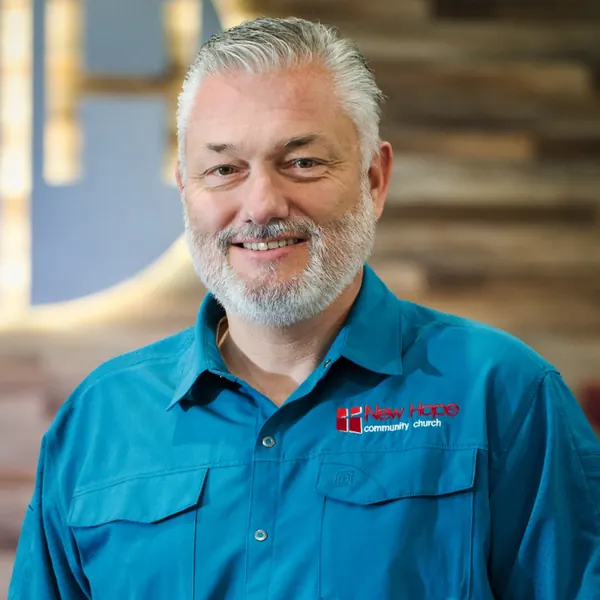
Mark
Addis
Senior Pastor of New Hope Community Church.
Senior Pastor at New Hope since December 2022. Joined as an elder board member and Associate Pastor in 2016. Master's from Moody Bible Institute, and a Commercial Pilot license.
This message is part of A Summer with C.S. Lewis, an eight week series on the man whose books have pointed so many people toward Christ. Every message in the series is gathered there.
You're welcome at New Hope.
All three Sunday services at 8, 9:30, and 11 AM are identical, same teaching and same worship, so come at the hour that works for you.
Get directions (opens Google Maps in a new tab)