


The law written on us.
Scripture in this message: Ephesians 4:1-6
This is the message as Pastor Mark wrote it, lightly edited so it reads clearly on the page. It is his prepared text, so it may differ here and there from what he said on Sunday.
Quotations from C.S. Lewis are shortened, with the surrounding summary in Pastor Mark's own words.
The message
Imagine standing on a London street corner in the autumn of 1940.
It is 8:00 pm, and the air raid sirens begin their terrifying wail.
The city goes pitch black, a mandatory blackout. For 56 consecutive nights, high-explosive bombs rain down from the sky, more than 700 tons of explosives.
I can almost hear my own grandmother's voice in this description. She drove an ambulance through the bombed and burning streets of London while my grandfather flew Wellington bombers.
In London, you can hear the low drone of enemy bombers overhead, the thunderous crunches of buildings collapsing just a few blocks away, and the smoke and brick dust fills your lungs.
Families are huddled in damp underground subway stations, clutching their children, wondering if their homes, or their lives, will still be there in the morning.
It was a season of absolute, paralyzing uncertainty.
People weren't just questioning their political future, they were questioning the very existence of a good God.
They were asking the big, raw questions.
Is there any purpose to this pain?
Is there really a right and a wrong?
Does anyone actually hold this shattered universe together?
In the midst of this national trauma, the BBC (the British Broadcasting Corporation) decided they needed to broadcast something that offered deep, intellectual, and spiritual grounding to a terrified population.
They didn't hire a famous politician as you might expect, or a loud street preacher.
Instead, they asked a brilliant, pipe-smoking Oxford literature professor who had spent the first half of his life as a hardened atheist.
His name was C.S. Lewis.
Now, think about the temptation Lewis faced.
He had a microphone that reached millions of anxious households.
He could have used that platform to debate complex church politics, argue about denominational doctrines, or get bogged down in some heavy, academic theological jargon that only other professors cared about.
Lewis knew that when bombs are falling, we don't have time for trivial things.
When your world is shaking, literally, we don't need a lecture on church architecture, we need to know if the foundation of the building will hold.
So, Lewis chose to speak only on what he called Mere Christianity.
Today, when we hear the word mere, we usually think it means barely enough or insignificant, like saying someone is a mere child.
In the 1940s, though, the word carried its older and original meaning.
It meant pure, unadulterated, and essential.
What "Mere" Actually Meant
Lewis wasn't trying to preach a watered-down, compromised version of faith.
He was trying to strip away all of the cultural clutter, the political baggage, and the religious division, to reveal the core, vibrant, undeniable essentials of the Gospel.
He wanted to focus on the common ground that unites all true followers of Jesus.
As we look at our own world today, it can feel like a different kind of Blitz is happening.
The cultural landscape is shifting, anxiety is at an all-time high, and it feels like the foundations of faith are being fractured by division and distractions.
That is why we are going to pause this morning and step out of the chaos and look at the essentials.
The Great Hall (Ephesians 4)
I said in week one that this work was a brilliant, step-by-step case for God, and Lewis famously wrote that this core faith is like the Great Hall of a grand house, this was an ongoing analogy.
It is the central room where everyone enters, meets, and finds common ground.
So this morning, we are going to walk into that Great Hall.
We are going to look at the timeless, bedrock truths of our faith that can withstand any storm, any cultural shift, and any bomb the world tries to drop on us.
Let’s start in Ephesians chapter 4, as we look at what truly unites us.
Ephesians 4:1-6 beautifully mirrors Lewis’s concept of the "Great Hall", the core, non-negotiable essentials that unite all Christians regardless of their differences.
“As a prisoner for the Lord, then, I urge you to live a life worthy of the calling you have received. 2 Be completely humble and gentle; be patient, bearing with one another in love. 3 Make every effort to keep the unity of the Spirit through the bond of peace. 4 There is one body and one Spirit, just as you were called to one hope when you were called; 5 one Lord, one faith, one baptism; 6 one God and Father of all, who is over all and through all and in all”
Ephesians 4:1-6
Let’s break this down as it applies to a House and a Great Hall in the House, the analogy used by Lewis.
Point 1: The Law of Nature
The First Point is the law of our nature, in other words: why do we need the house?
If you open the pages of Mere Christianity, you will notice something that’s a little surprising right from the very first chapter.
Lewis doesn’t start by quoting Genesis, and he doesn’t start by trying to prove the resurrection.
Instead, he starts by asking us to look at human nature.
He asks us to listen to a couple of ordinary people engaging in something that we have all come across, people having an everyday argument.
Think about the last time you got into a disagreement.
Maybe it was over a parking spot at the grocery store, a household chore that someone forgot to do, or even a high-stakes business deal.
What do we actually say when we argue?
We don't just make animal noises or lash out blindly like creatures driven purely by instinct, mostly!
We stick to a standard. We say things like:
"How would you like it if someone did that to you?"
"That’s my seat, I was here first."
"Leave him alone, he isn't doing you any harm."
Lewis points out something interesting about this defense mechanism.
He writes.
What mutineers or thieves or people shouting at each other mean is that the other person has broken some kind of rule or standard of fair play.
C.S. Lewis, Mere Christianity
Both parties, Lewis notices, have some rule of fair play or decent behavior in mind, and it is a rule they genuinely agree on.
He called this the Law of Human Nature, or the Moral Law.
Historically, people called it the Natural Law because it was believed that everyone knew it by nature, and didn’t need to be taught it, just like the law of gravity, we all became aware of that when we fell down as toddlers learning to walk!
This book though isn't just an Oxford professor's philosophical musing.
This is deeply biblical.
Long before C.S. Lewis spoke into a BBC microphone, the Apostle Paul described this exact phenomenon in his letter to the Romans.
In Romans 2:14-15, Paul writes about people groups who don't even have the written Old Testament scriptures.
“14 (Indeed, when Gentiles, who do not have the law, do by nature things required by the law, they are a law for themselves, even though they do not have the law. 15 They show that the requirements of the law are written on their hearts, their consciences also bearing witness, and their thoughts sometimes accusing them and at other times even defending them.)”
Romans 2:14-15
God didn’t leave humanity completely in the dark, just wandering without a compass.
He stamped His own moral fingerprint onto the very fabric of the human conscience.
This means that whether you are walking the streets of London, standing in the bright lights of Times Square New York, or visiting a remote village in Uganda, human beings inherently share a baseline code.
We know that courage is better than cowardice, that honesty is better than lies, and that serving others is more compassionate than abandoning them.
We argue because we expect the other person to know the rulebook.
This leaves humanity trapped in a massive, but universal predicament.
Lewis argues that across all civilizations, all timelines, and all cultures, two facts stand out as the bedrock and unshakeable truth:
First, human beings, all over the earth, have this definitive idea that they ought to behave in a certain way.
Second, they do not do so.
This is where the sermon gets somewhat personal, and this is where we have to stop looking at our neighbors (especially our spouse!), and look directly into the mirror.
We love the law when it protects us, but we complain about it when it restricts us.
As is typical with him, Lewis writes with razor-sharp honesty.
None of us are really keeping the Law of Nature. If we do not believe in decent behavior, why should we be so anxious to make excuses for not having behaved decently?
C.S. Lewis, Mere Christianity
We believe in decency so much, he says, that we cannot bear to face our own breaking of it, so we shift the responsibility instead.
Think about how incredibly creative we are at inventing excuses.
When we are sharp, rude, or impatient with our families, we immediately excuse ourselves by saying it’s because we had a stressful day at work or didn't sleep well.
We treat our own failures as situational.
When someone else cuts us off in traffic or snaps at us in the hallway, though, we immediately label it a character flaw.
We often have a broken moral compass inside of us.
We often demand perfection from others, while begging for passes for ourselves.
This tension in ourselves is the first major clue to the reality of the universe.
In Romans 3:23, Paul brings the hammer down, as he usually does!
“For all have sinned and fall short of the glory of God”
Romans 3:23
The Moral Law is like a mirror.
A mirror is incredibly useful, but it has a distinct limitation, it can show you that your face is covered in dirt, but it cannot reach out and wash your face for you.
It can diagnose the problem, but it cannot provide the cure.
Before we can ever appreciate the amazing good news of a Savior in our lives, we have to sit in the heavy, bad news of our spiritual condition.
The Moral Law isn't just a shifting social construct, in other words made up by humanity and changing according to who is managing it, it's a universal diagnostic tool, it’s built in.
It shows us that there is a Holy Architect who built this universe with an absolute standard of beauty and righteousness, and we have completely vandalized His design.
We don't just need a self-help coach to give us a few lifestyle tips or a therapist to tell us we are doing great.
We need a Rescuer to pull us out of the wreckage of our own brokenness.
Our failure under the law proves why we desperately need to step into the House.
Point 2: Who Owns the House
The second point today is this: if we need the house, then who owns the house?
Once this Moral Law forces us out of our self-righteousness, and into the realization that we need a Rescuer, we have to look closely into history to see who has actually shown up to save us.
That search brings us face-to-face with a first-century carpenter from Nazareth.
In our culture today, there is a very popular, very comfortable way to handle Jesus.
You’ve probably heard it in college classrooms, on podcasts, or even from family.
They might say:
"I think Jesus was a wonderful moral teacher. I love His golden rule, and I think He was a great philosopher. But I just can't accept His radical claims to be God."
Lewis looks at that casual, modern argument and completely dismantles it with logic.
He forces us to realize that Jesus of Nazareth never left us the option to view Him as just a safe and inspiring teacher.
Lewis wrote one of the most famous passages in Christian literature to explain why.
I am trying here to prevent anyone saying the really foolish thing that people often say about Him: 'I'm ready to accept Jesus as a great moral teacher, but I don't accept His claim to be God.' That is the one thing we must not say.
C.S. Lewis, Mere Christianity
Lewis's point is blunt: those claims rule out the comfortable middle ground people like to stand on. Either Jesus was telling the truth about who He was, or He was dangerously mistaken, or He was lying, and none of those three leaves room for calling Him simply a wise moral teacher.
Why does Lewis use relatively shocking language here?
Because of what Jesus actually did and said in the pages of the Gospels.
Think about Mark 2:1-12.
A paralyzed man is carried by his friends, it was crowded, and out of desperation, they cut a hole through a roof to lower him down right in front of Jesus.
Everyone expects Jesus to talk about the obvious physical paralysis of the man.
Jesus looks at him and says something completely unexpected.
Son, your sins are forgiven.
The religious leaders sitting in the corners instantly gasped.
They started whispering among themselves, saying:
"Who can forgive sins but God alone?"
They were exactly right!
Think about it: if someone robs you or hurts your family, and I walk up to that criminal and say, "Don't worry about it, I forgive you,", you would look at me like I had completely lost my mind.
The only person who has the right to forgive an offense is the specific person who was wronged by it.
Lewis explains the staggering arrogance of Jesus's behavior if He were just a normal man.
He told people that their sins were forgiven. This makes sense only if He really was the God whose laws are broken and whose love is wounded in every sin.
C.S. Lewis, Mere Christianity
In anyone else's mouth, Lewis adds, those words would be conceit unmatched by any figure in history.
Jesus didn't just hand out moral recipes.
He claimed to be the very Chef who created existence.
This forces us into an obvious and unavoidable decision.
This is Lewis's famous trilemma, and it breaks down into three clear options:
Option A: He was a Liar.
He knew He wasn't God, but He intentionally deceived millions of people, making Him a demonic, malicious fraud.
Option B: He was a Lunatic.
He genuinely believed He was the Lord of the universe, but He was totally self-deluded, operating on the level of someone who thinks they are a piece of breakfast food.
Option C: He is exactly who He said He was: Lord.
In Matthew 16:15, Jesus looks directly at His disciples, and He looks directly into our eyes today, and asks the ultimate question:
“But what about you?” he asked. “Who do you say I am?”
Matthew 16:15
The fact is, we cannot keep Jesus at arm's length as an inspiring, safe, historical ornament.
Liar, Lunatic, or Lord
If He is a liar or a lunatic, we should delete Him entirely from our lives.
If He is Lord, He demands our absolute, unconditional surrender to Him.
He isn't a casual guest renting a room in your life. He built the property. He bought it back with His blood, and He owns the entire house.
The third point is about what ruined the fellowship?
If we accept that Jesus is Lord, and we step through the front door into this Great Hall of faith together, we immediately hit a massive, internal roadblock.
It’s the single greatest threat to Christian community, to marriages, and to individual souls.
Point 3: Pride, the Great Sin
Lewis dedicates an entire, searing chapter to it in the heart of the book, and he calls it “The Great Sin”.
That sin is Pride.
Lewis argues that pride is the ultimate vice. It is the spiritual cancer that stands in direct, total opposition to God.
Immorality, anger, greed, gossip, those are bad, but they are essentially animal vices driven by our flesh.
Pride, however, is a purely spiritual sin. Lewis wrote:
There is one vice of which no man in the world is free; which every one in the world loathes when he sees it in someone else; and of which hardly any people, except Christians, ever imagine that they are guilty themselves. The essential vice, the utmost evil, is Pride.
C.S. Lewis, Mere Christianity
Lewis ranks it above every other sin he names. Pride is the root sin, the one that turned an angel into the enemy of God, because it puts the self exactly where God belongs.
The writers of Scripture don't mince words when it comes to this sin.
In James 4:6 and 1 Peter 5:5, we are told that God opposes the proud but shows favor to the humble.
Take note of that word, opposes.
In the original Greek language, it means to line up an army in battle array against an enemy.
God doesn't just tolerate pride with a disappointed sigh. He actively fights against it.
Why is pride so uniquely opposed to God?
Because pride is inherently competitive. Lewis points out that pride doesn't get any actual pleasure out of simply having a blessing, it only gets pleasure out of having more of it than the person standing next to you.
Pride is competitive by its very nature. Pride gets no pleasure out of having something, only out of having more of it than the next man.
C.S. Lewis, Mere Christianity
Nobody is proud of being rich, he goes on, only of being richer. Take the comparison away and there is nothing left to be proud of.
Pride is the reason why we look around a church sanctuary and compare ourselves to others.
It’s the reason why we celebrate subtly when someone else fails, because it makes us look better by comparison.
The scariest dynamic of pride, though, is that it functions as a spiritual blind spot.
It is the one sin we can spot instantly in our spouse, our boss, or our neighbor, but completely miss when we look in the mirror.
It builds an impenetrable wall between us and God, as Lewis noted:
In God you come against something which is in every respect immeasurably superior to yourself. Unless you know God as that, and, therefore, know yourself as nothing in comparison, you do not know God at all.
C.S. Lewis, Mere Christianity
Lewis's picture is a posture, not a mood: pride fixes your eyes downward, comparing yourself to whoever is beneath you, and eyes fixed down never lift high enough to see God.
If you are constantly looking down at those you think are spiritually beneath you, your neck is bent in the wrong direction to ever look up at the majesty of a holy God.
The biblical antidote to this terrible cancer is found in Philippians 2:3:
“3 Do nothing out of selfish ambition or vain conceit. Rather, in humility value others above yourselves”
Philippians 2:3
Humility isn't not making eye contact, or putting yourself down, and telling everyone how terrible you are.
True humility, as Lewis famously said, is not thinking less of yourself, but thinking of yourself less.
It’s turning your gaze away from your own mirror, looking at Christ so intently, and loving others so deeply, that you simply forget to worry about your own status, your own rights, and your own reputation.
So, how do we defeat this deeply ingrained pride?
How do we actually change our hearts?
This brings us to the beautiful, theological climax of Mere Christianity.
Lewis reminds us that Christianity isn't just a philosophy, and it’s not a moral checklist where you try really hard to put on a smile and be a good person.
If Christianity were just about trying harder to follow rules, we would fail just as miserably as we failed the Moral Law.
A Good Infection: Two Kinds of Life
To explain this transformation, Lewis looks at the contrast between two different words the original writers of the New Testament used for life, Bios and Zoe.
Bios is our natural, biological life. It is the life of bones, blood, and muscle, the kind of life that runs down, gets sick, and eventually dies.
Zoe is the spiritual, eternal, uncreated life of God Himself. It is the dynamic, roaring life that existed before time began.
By nature, every single one of us is born with only Bios.
We are born physically alive, but spiritually barren.
God didn't create us just to grow old and decay.
In John 10:10, Jesus declared, “I have come that they may have life [Zoe], and have it to the full.”
This means that salvation is not just a little behavior modification or an update to your habits. It is a total metaphysical renovation.
In Ephesians 2:4-5, Paul writes.
“But because of his great love for us, God, who is rich in mercy, made us alive with Christ even when we were dead in transgressions”
Ephesians 2:4-5
Notice he doesn't say He made us better. He says He made us alive.
Lewis illustrates this ultimate transformation with a brilliant parable about a toy room filled with tin soldiers.
Imagine them standing on a shelf, they are stiff, cold, and completely dead.
Then, suddenly, a real, living, breathing human being walks into the room.
Lewis writes.
The Son of God became a man to enable men to become sons of God. Imagine turning a tin soldier into a live man. It would change the tin completely. The tin soldier would not like it.
C.S. Lewis, Mere Christianity
The soldier would think the tin was being ruined, Lewis says, and being made alive is precisely what Christ came to do.
Seems like a good time to talk about this, with the new Toy Story out right now!
If that living man could breathe his own warm, vibrant life into those metal figures, though, their stiff joints would begin to soften.
Real blood would start pumping through their veins. They would be turned from cold, rigid metal objects into living, feeling, running human beings.
That is exactly what happens inside the house of faith.
Christ didn't come to teach tin soldiers how to stand in a straighter line or polish their metal uniforms. He came to kill the tin and give them real life!
When we read Scripture, when we pray, when we gather around the table in Christian community, we are putting ourselves directly in the way of that "good infection."
We are hanging out around the source of life until it rubs off on us.
Lewis concludes with this profound reality:
"Every Christian is to become a little Christ. The whole purpose of becoming a Christian is simply nothing else."
Mere Christianity
Holiness is not a legalistic checklist, it is an environment of grace we steep ourselves in until our proud, cold hearts begin to soften, the stiff tin of our old nature melts away, and we begin to look, love, and live just like our Savior.
This morning, as we step back today and look at the grand architecture of Mere Christianity, we have to return one last time to that central image of the Great Hall.
The "mere" essentials of our faith, the reality of the Moral Law that exposes our desperate need, the absolute and shocking Lordship of Jesus Christ, the relentless battle against the spiritual cancer of pride, and the breathtaking reality of catching the "good infection" of God’s own life, this is the common ground where we all stand.
This is the bedrock truth that unites every believer across history.
It is a beautiful place of unity.
Hear the final warning that Lewis leaves us with at the end of his book.
He tells us very plainly:
"The hall is a place to wait in, a place from which to try the various doors, not a place to live in. It is in the rooms, not in the hall, that there are fires and chairs and meals."
Mere Christianity
Some of you here today have been standing in the hallway for a very long time.
You like the intellectual idea of Jesus, you like the history, and you enjoy the safety of the concept of faith.
Yet you have kept your distance from real, committed, and frequently messy Christian living.
You haven’t joined a room.
You haven’t committed your life to a local body of believers, and you haven’t anchored your life to the spiritual disciplines where the fire is lit and the true spiritual food is served.
The Challenge: Step Out and Open the Door
Step out of the passive hallway of mere belief.
Lay your heavy pride down at the threshold, submit to Jesus as the absolute Lord of your life, and step into the room where the Holy Spirit can transform you from a stiff tin soldier into a living, breathing child of God.
Our calling as the church, though, doesn’t end with us finding a comfortable chair by the fire inside our favorite room.
If we truly understand Mere Christianity, we have to remember the terrifying context in which these words were first spoken.
Remember the London Blitz.
Air Raid Wardens in the Dark
Remember the air raid sirens screaming through the night and the bombs falling in the pitch black.
The terrified people of London weren't standing outside on the sidewalks admiring the beautiful architecture of their homes, they were running for their lives, desperately looking for a shelter that could withstand the destruction raining down around them.
We live in a world right now that is undergoing its own devastating spiritual Blitz.
People all around us, your neighbors across the street, your co-workers in the next cubicle, your family members at the dinner table, so many are living in total spiritual darkness.
They are watching the foundations of their lives crumble to pieces under the weight of anxiety, brokenness, and quiet despair.
They are trying to survive the wreckage of their own fractured morality, desperately seeking a shelter that can actually hold.
We cannot afford to sit comfortably inside our theological rooms, warming our hands by the fire and enjoying the sweetness of our fellowship, while the world outside our walls is being torn apart.
As Lewis famously wrote in his masterpiece essay, The Weight of Glory, and we will get to this one.
There are no ordinary people. You have never talked to a mere mortal. Nations, cultures, arts, civilizations, these are mortal, and their life is to ours as the life of a gnat.
C.S. Lewis, The Weight of Glory
Lewis's point is not poetic exaggeration. The people you pass in the grocery line, argue with online, or drive past every day are headed somewhere eternal, either everlasting joy or everlasting ruin, and Lewis wants that fact to change how casually we treat one another.
Every single person you lock eyes with this week is an immortal soul who desperately needs the safety of the Great Hall.
True evangelism is not about forcing people into complex theological arguments, beating them into submission with doctrine, or debating church politics.
Evangelism, at its very core, is simply walking out to the front porch of the house, looking out into the cold darkness, and guiding terrified, broken people toward the light.
It is doing exactly what Jesus called us to do in the Great Commission, inviting them out of the storm and into the "good infection" of God’s saving grace.
We have been given a foundation that cannot be shaken by any cultural shift or personal trial.
We know the Lord of the House. So this week, let’s do two things:
First, step out of the hallway. Stop being a passive observer of Christianity and commit to the deep, transforming life inside the room of true discipleship.
Second, open the front door. Go out into the darkness of the world, find someone who is weary and broken by the storm, and invite them into the Great Hall of God's mercy.
Imagine once more that dark, smoke-filled night in 1940s London.
When the air raid sirens sounded, there were two kinds of people in the city.
There were those who were already safe inside the deep underground shelters, feeling the ground shake but resting in the knowledge that the ceiling would hold.
Then there were the Air Raid Wardens and ambulance drivers like my grandmother, ordinary citizens who put on heavy helmets, stepped out into the dangerous darkness, and carried flashlights into the burning streets, and drove the wounded to safety.
As the bombs fell, those brave wardens didn't stay huddled safely inside the shelter.
They went directly into the rubble. They listened intently for the faint cries of people trapped under fallen bricks and shattered timber.
They pointed their flashlights into the dust and shouted into the darkness.
"Over here! There’s room in the shelter! Follow my light!"
C.S. Lewis didn’t give those radio talks to entertain the people who were already safe inside the shelters.
He gave them to be a searchlight in the smoke and dust for those who were lost.
Today, Jesus Christ is not looking for a church that treats His house like a private, gated country club for the saved.
He is looking for Air Raid Wardens.
The gospel of Jesus Christ is an unshakeable fortress.
It has withstood the rise and fall of brutal empires, the seismic shifts of human cultures, and the deepest intellectual doubts of human history.
The foundation holds. The roof will never cave in. Inside this House, there is life, there is warmth, and there is a seat at the table with your name on it.
As you look at the person sitting next to you today, though, and as you think about the people you will encounter the very moment you walk through those exit doors, remember what is at stake.
We are not playing a polite religious game.
We are living in a world under siege, and we hold the keys to the only shelter that lasts for eternity.
Do not leave this building today content to just know the truth.
Live the truth.
Step out of the hallway of passive belief, pull up a chair in the room of deep discipleship, and then turn right around, open the front door, and shine your light into the dark.
Find the broken, find the searching, find the bleeding, and tell them:
"I know a House. I know the Lord who built it. And there is still room inside."
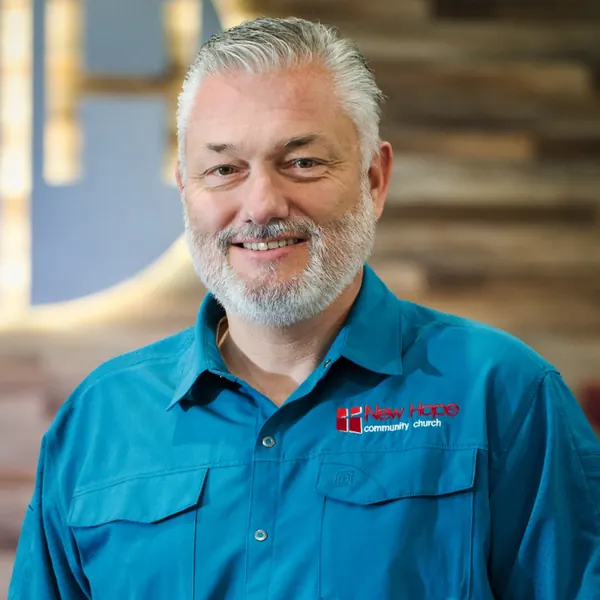
Mark
Addis
Senior Pastor of New Hope Community Church.
Senior Pastor at New Hope since December 2022. Joined as an elder board member and Associate Pastor in 2016. Master's from Moody Bible Institute, and a Commercial Pilot license.
This message is part of A Summer with C.S. Lewis, an eight week series on the man whose books have pointed so many people toward Christ. Every message in the series is gathered there.
You're welcome at New Hope.
All three Sunday services at 8, 9:30, and 11 AM are identical, same teaching and same worship, so come at the hour that works for you.
Get directions (opens Google Maps in a new tab)